Saturday, November 21, 2026

* All product/brand names, logos, and trademarks are property of their respective owners.
A teenager stares at a blank paragraph, asks an AI tool for help, and receives a polished answer in seconds. The result sounds confident, organized, and strangely unlike them. The immediate problem seems solved. A harder question remains: how can a young person use assistance without letting the tool take over the thinking and language that make the work theirs?
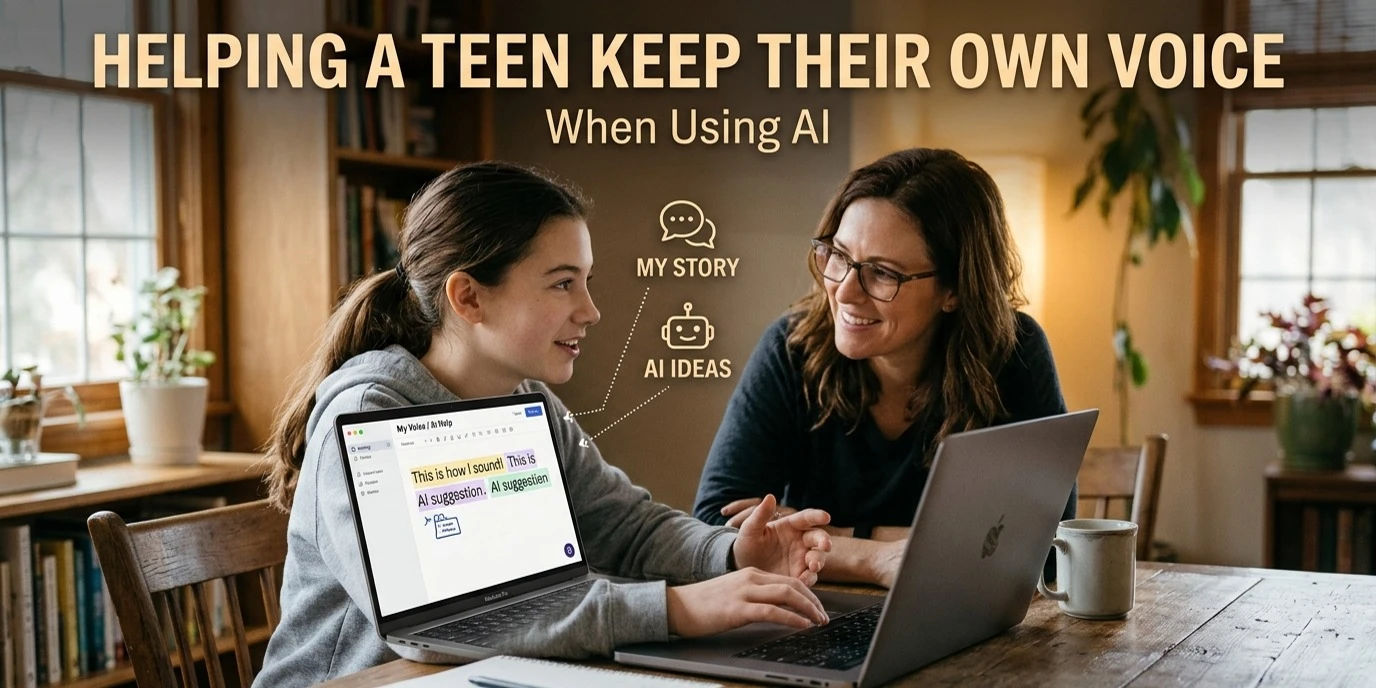
Families do not need to choose between banning every AI tool and accepting every generated sentence. They can teach a slower process: begin with the teen's idea, use the tool for a defined task, verify claims, and revise until the final work sounds like a person who can explain it. Voice is not a special writing effect. It is the record of choices the young person understands and owns.
Ask the teen to write a rough note about what they think. It can be messy. A few sentences, questions, or a spoken recording gives them a starting position before the tool offers its preferred structure.
This step matters because the first fluent answer can anchor the whole task. Once a polished paragraph exists, it becomes difficult to remember what the student originally wanted to say. A rough note protects the idea from being replaced by convenience.
Keep the note. At the end, compare it with the final work. The subject may have developed, but the teen should be able to point to decisions they made rather than merely accepting the first response.
“Write my essay” hands over the central task. A narrower request can support the student's work: suggest questions about a topic, identify an unclear transition, or offer several ways to organize points the teen already chose.
The boundary depends on the assignment and school rules. Check the teacher's current guidance before using the tool. Assistance permitted for brainstorming may be prohibited for final wording, coding, translation, or assessment.
Write the purpose of the prompt at the top of the notes. This makes it easier to explain how the tool was used and to stop when it begins doing more than intended.
Do not paste names, addresses, school records, health information, private messages, or account details into a general AI prompt. Use initials or invented examples when context is necessary. Include only the minimum text needed for the specific task.
Read the service's current privacy and retention information. Settings and age requirements differ and can change. A family account, school account, and public tool may not handle information in the same way.
Teach the teen that deleting a visible chat may not answer every question about provider retention. When the data practice is unclear, choose a less sensitive way to get help.
A tool can provide three possible openings, several counterarguments, or questions a skeptical reader might ask. The teen then selects, rejects, or combines ideas with an explanation.
Choice keeps the student active. Ask why one option fits and another does not. If the answer is only “this sounds smarter,” return to the intended audience and meaning. Sophisticated vocabulary is not evidence of clearer thought.
Encourage the teen to change the structure, not merely swap a few words. A sentence remains foreign to their voice if they cannot explain its claim or defend its tone.
Generative systems can produce false or unsupported content in fluent language. The NIST Generative AI Profile discusses confabulation as a risk. Confidence, detail, and citation-like formatting do not make a statement reliable.
Have the teen mark each factual claim and locate an appropriate source independently. Open the source, check that it says what the draft claims, and record the author, date, and context required by the assignment.
If a source cannot be found, remove or rewrite the claim. Do not ask the same system to confirm its own answer and treat agreement as verification.
Young writers often feel pressure to sound certain. AI output can intensify that pressure by presenting one clean answer. Teach the teen to use words such as may, suggests, and according to the available evidence when those qualifications are accurate.
Ask what the writer does not know. Naming a limit can strengthen an argument because it shows where the evidence ends. Removing every uncertainty may make the prose sound decisive while making the reasoning weaker.
Do not invent a personal experience to make generated text feel human. Authentic voice can include a question, a carefully observed example, or a clearly stated interpretation without a dramatic story.
Parents can ask what the teen is trying to say before editing sentences. Teachers and peers can respond to meaning, evidence, and audience in ways a tool cannot fully reproduce. Human feedback also carries responsibility and knowledge of the assignment context.
Avoid rewriting the work into the parent's voice. A parent who replaces every sentence creates the same ownership problem as a generator. Ask questions, point to confusion, and let the teen make the revision.
If the topic involves distress, relationships, safety, health, or law, use an appropriate qualified person rather than relying on generated guidance. A writing helper is not a substitute for care or professional judgment.
The same principles apply to music, images, video, and code. Begin with the teen's purpose, define the tool's role, verify external claims, respect rights, and preserve decisions the teen can explain.
Ask whether the tool learned from, imitates, or transforms material in ways relevant to the platform or assignment. Rules and licensing questions vary. Avoid claiming ownership or originality beyond what the teen actually contributed.
TheOneSpy's illustrated digital journey across 2010, 2020, 2026, and 2035 can prompt a conversation about the shift from consuming content to creating with AI. Its 2035 scenes imagine possibilities; they do not predict one teenager's future.
If a school, publisher, or platform requires AI disclosure, follow the rule. Even without formal rules, the teen should describe the assistance honestly. A simple note can identify the tool and purpose accurately, avoiding false “human-written” labels if generated text remains. Disclosure isn't failure; it’s responsible authorship, like acknowledging feedback, and grows more valuable as AI blends into everyday software.
After the task, ask what the teen understands now. Can they explain the argument off-screen, identify a corrected claim, or describe a choice they made? If allowed, keep one brief before-and-after example—stripped of personal prompt details—to remember key decisions rather than archiving everything. If they only learned to get quick answers, narrow the tool's role next time; if it helped them weigh alternatives or revise deliberately, keep that process.
Voice grows through use. It survives assistance when the young person starts with an idea, directs the tool, verifies its output, and makes the final decisions. The best result isn't prose that beats a detector—it's work the teen understands well enough to stand behind.

In this guide, you will learn everything you need to know about infant car seats in 2026, from what
15 September 2026
Every parent remembers the moment their child first sat behind the wheel of a kids' car and pressed
27 July 2026
Be the first to share your thoughts
No comments yet. Be the first to comment!
Share your thoughts and join the discussion below.